
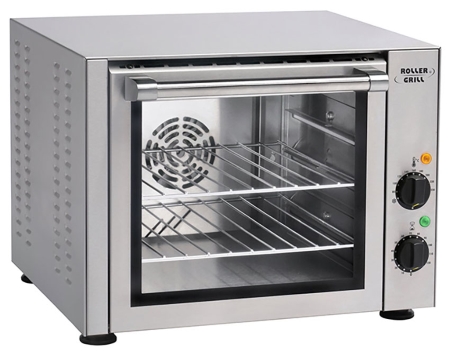
A convection oven has a blower fan which circulates hot air throughout the oven, eliminating cold spots and promoting rapid cooking. Overall, cooking temperatures and times are shorter than in conventional ovens. The size, thickness, type of food, and amount loaded into the oven at one time will influence the cooking time.
TEMPERATURE SETTINGS:
Follow the recommended temperature guide provided in the manufacturer’s operating manual. If not available, follow the guidelines furnished on this card or check specific recipe for convection oven information. Note: At this time, not all AFRS oven recipes contain convection information. If food is cooked around the edges, but the center is still raw or not thoroughly cooked, or if there is much color variation (some is normal), reduce the heat by 15°F. to 25°F. and return food to the oven. If necessary, continue to reduce the heat on successive loads until the desired results are achieved. Record most successful temperature on the recipe card for future reference.
TIME SETTING:
Follow the recommended times provided in the manufacturer’s operating manual. Should the manual not be available, follow the guidelines furnished on this card or check the specific recipe for convection oven information. Check progress halfway through the cooking cycle since time will vary with the quantity of food loaded, the temperature, and the type of pan used. Note: meat thermometers for roasting, and visual examination of baked products are the most accurate methods of determining cooking times, both in convection ovens and in conventional ovens. Record most successful cooking time on the recipe card for future reference.
VENT DAMPER CONTROL SETTING:
The vent damper control is located on or near the control panel. The damper should be kept closed for most foods of low moisture content such as roasts. If open during roasting, meats will be dry with excessive shrinkage.
The damper should be kept open when baking high moisture content foods (cakes, muffins, yeast bread, etc.). Leaving the damper closed throughout a baking cycle will produce cakes which are too moist and will not rise. A “cloud” or water droplets on the window indicate excessive moisture which should be vented out of the oven through the open damper.
FAN SPEED SETTINGS: SEE GENERAL NOTES BELOW.
INTERIOR OVEN LIGHTS:
Turn on lights only when loading, unloading, or checking product. Continual burning of lights will result in short bulb life.
TIMER:
The oven timer will ring only as a reminder; it has no control over the functioning of the oven. To ensure proper operation, wind the timer to the maximum setting, then turn back to the desired setting for the product.
GENERAL OPERATION:
- Select and make the proper rack arrangement for the product to be cooked.
- Turn or push the main power switch “ON” (gas oven–turn burner valve “ON”). Set thermostat to the recommended temperature. The thermostat signal light will light. Adjust fan speed on two-speed blower, if available (see General Notes below)
- PREHEAT oven until thermostat signal light goes out indicating that the oven has reached the desired temperature. The oven should preheat to 350°F. within 10 to 15 minutes. (Note: To conserve energy, DO NOT turn on the oven until absolutely necessary-about 15 minutes before actual cooking is to start.)
- OPEN oven doors and load the oven quickly to prevent excessive loss of heat. Load the oven from the top, centering the pans on the rack toward the front of the oven. Place partial loads in the center of the oven. Allow 1 to 2 inches between pans and along oven sides to permit good air circulation. Remember–overloading is the major cause of nonuniform baking and roasting.
- Close oven doors and set the timer for the desired cooking time. Check the baking/roasting progress periodically until product is ready.
CLEANING AND MAINTENANCE:
Refer to the manufacturer’s operating manual for cleaning and maintenance instructions.
GENERAL NOTES:
Most convection ovens are equipped with an electric interlock which energizes/de-energizes both the heating elements and the fan motor when the doors are closed/open. Therefore, the heating elements and fan will not operate independently and will only operate with the doors closed.
(Only one known company manufactures an oven in which the fan can be controlled independently.) Some convection ovens are equipped with single-speed fan motors while others are equipped with two-speed fan motors. This information is particularly important to note when baking cakes, muffins or meringue pies, or similar products, and when oven-frying bacon.
High speed air circulation may cause damage to the food (e.g., cakes slope to one side of the pan) or blow melted fat throughout the oven. Read the manufacturer’s manuals and determine exactly what features you have and then, for the above products, proceed as follows.
Two-Speed Interlocked Fan Motor: Set fan speed to “low.”
Single-Speed Interlocked Fan Motor: Preheat oven 50°F. higher than the recommended cooking temperature. Load oven quickly, close doors, and reduce thermostat to recommended cooking temperature. (This action will allow the product to “set up” before the fan/heating elements come on again.)
Single-Speed Independent Fan Motor:
- Preheat oven 25°F. above temperature specified in recipe.
- Turn fan “OFF.”
- Reduce heat 25°F.
- Load oven quickly and close doors.
- Turn fan “ON” after 7 to 10 minutes and keep “ON” for remaining cooking time.
EXCEPTION: Leave fan “OFF” for bacon to prevent fat from blowing throughout the oven.READ AND UNDERSTAND THE MANUFACTURER’S MANUALS. THEY WILL MAKE YOUR JOB EASIER.
Note: Equipment is becoming more and more complex as the “state-of-the-art” progresses.
It is absolutely essential that proper operating manuals be read and understood by everyone who either uses or maintains food service equipment. If you do not have the proper manuals available, proceed with extreme caution so as not to damage or misuse this equipment. Local food service equipment dealers, and/or your service’s food service office should be contacted for assistance.
FOODPAN SIZE
(INCHES)RECOMMENDED NO.
OF SHELVES FOR
ONE LOADRECOMMENDED
TEMPERATURE
(°F.)TIME
| BREADS | ||||
| Breads, yeast | 10-1/2 by 5 by 3-1/2 | 3 | 375 | 30 min |
| Coffee cakes | 18 by 26 | 4 | 325 | 15 min |
| Muffins | 12-cup muffin pan | 4 | 350 | 30 min |
| Rolls, yeast | 18 by 26 | 4 | 350 | 10 to 15 min |
| Sweet rolls | 18 by 26 | 4 | 325 | 15 min |
| CAKES | ||||
| Angel food | 16 by 4-1/2 by 4-1/8 | 3 | 300 | 25 to 30 min |
| Layer | 8 or 9 | 4 | 300 | 25 to 35 min |
| Loaf | 16 by 4-1/2 by 4-1/8 | 3 | 325 | 65 min |
| Sheet | 18 by 26 | 4 | 300 to 325 | 25 to 35 min |
| DESSERTS | ||||
| Brownies | 18 by 26 | 4 | 325 | 25 to 30 min |
| Cookies, bar | 18 by 26 | 5 | 325 | 15 min |
| Cookies, drop | 18 by 26 | 5 | 325 | 12 min |
| Cookies, sliced | 18 by 26 | 5 | 350 | 8 to 10 min |
| Pies, fruit | 9 | 4 | 375 | 25 min |
| MEATS | ||||
| Bacon, oven fried | 18 by 26 | 5 | 325 | 15 to 20 min |
| Chicken, quarters or pieces | 18 by 26 | 5 | 350 | 30 min |
| Fish, baked or oven fried | 18 by 26 | 4 | 325 | 15 to 20 min |
| Meat loaf | 18 by 26 | 3 | 300 | 1 hr 15 min |
| Roasts, boneless, Beef | 18 by 26 | 3 | 325 | 1 hr 45 min |
| Roasts, boneless, Pork | 18 by 26 | 3 | 325 | 1-1/2 to 2 hrs |
| Steak, grill (strip loin, ribeye roll, top sirloin butt) |
18 by 26 | 7 | 400 | See Recipe |
| Turkey, boneless | 18 by 26 | 3 | 325 | 3-1/2 to 4 hrs |
| MISCELLANEOUS | ||||
| Pizza | 18 by 26 | 4 | 450 | 15 min |
| Potatoes, baked | 18 by 26 | 5 | 400 | 35 to 40 min |