There are several varieties of chicken available to the consumer, such as regular chicken, Cornish game hens, and poussin, also known as spring chicken. Cornish game hens are very small pump chickens that are a cross between a Cornish and Plymouth Rock chicken. They produce a greater amount of white meat in comparison to their dark meat, than other birds and the meat is very tender. The Cornish hen generally weighs between 1 and 2 pounds and is prepared as a single serving. A poussin is an extremely young, small chicken, and it provides a very mild flavor. Because it is so young, it has very little fat. Regular chickens are classified according to their age. Listed below are the common
classifications.
| Broiler-Fryer |
A chicken ranging in age from 7 to
13 weeks and weighing from 1-1/2 to 4 pounds.
Their meat is very tender and they can be
prepared by most any cooking method, such as
broiling, braising, frying, roasting, and
grilling. Depending on their size, a
broiler-fryer will generally serve 3 or 4
people. |
| Roaster |
A chicken ranging in age from 3 to 5 months
and weighing from 3-1/2 to 7 pounds. Their meat
is tender and more flavorful that the
broiler-fryer chickens. They make a good
roasting chicken but can be prepared by other
methods and are good in other dishes. A roaster
chicken will generally serve approximately 5 to
7 people. |
Stewing
Chickens |
A mature chicken, which is over 10
months old and weighing in the range of 4 to 7
pounds. Their meat is very flavorful but tougher
than that of the broiler-fryers and roasters.
They are best used for stews and soups, or
should be cooked slowly with a moist heat method
such as simmering or braising. |
| Capons |
Male chickens that have been
castrated. They are generally under 8 months old
and will weigh in the range of 5 to 9 pounds.
The capon has more white meat but generally has
a higher fat content. Their meat is the most
flavorable of all the chickens and it is very
tender. Capons are great roasting chickens and
will serve approximately 6 to 9
people. |
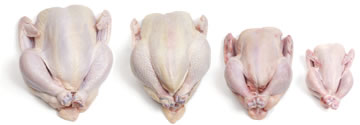 |
|
Roaster |
Capon |
Boiler/Fryer |
Cornish Game Hen |
|
| The picture above illustrates the difference in size between some of the different types of chickens. |
Chickens are also classified according to the
method used to raise them. Each method has an
effect on the quality of meat. Shown below are
some of the methods used.
| Natural |
Chickens can be labeled as
“natural” if it does not contain any chemical
preservative, artificial coloring or flavoring,
or any other synthetic substance. It can be
processed using traditional methods, such as
freezing, smoking, roasting, and drying. These
minimal USDA standards allow even chickens that
have been treated with antibiotics and growth
enhancers to be classified as
“natural.” |
| Free-Range |
Chickens labeled “free-range” have only one
requirement, which is that it must have had
access to an outside environment. Free-range
chickens are thought to have more flavor, but
generally have a tougher meat. The chickens may
have been exposed to antibiotics, growth
enhances, and steroids. |
| Organic |
Chickens labeled “organic” must be
certified by a certification entity. To be
certified the chickens must be fed organic feed
that is made up of grains and soybeans that have
been grown in soil that has not been exposed to
chemical fertilizers, pesticides, or other
harmful chemicals. They cannot be treated with
any drugs or antibiotics, and they must have
outside access. Organic chickens are available
for those concerned with consuming a healthier
meat and promoting a healthier environment for
animals and humans. |
| Kosher |
A kosher chicken must be raised
and processed with strict guidelines under
rabbinical supervision. The chickens are fed
only grain and are free-range. They are never
given any antibiotics and they are individually
inspected. When they are processed, the chickens
are soaked in a salty brine solution to give the
meat a unique flavor. |
| Conventional |
Conventionally raised chickens are
raised under confined conditions without
exposure to natural sunlight or access to the
outside environment. Due to these conditions,
growth enhancers are sometimes used to promote
growth and the need for antibiotics is greater.
Often the conditions are overcrowded and the
feed used has potentially been exposed to
harmful chemicals. Chickens raised under
conventional methods have less flavor than those
raised by other methods, such as free-range or
organic. |
There are other descriptive terms used to
identify chicken that should be understood. Some
of the terms, which can apply to most any chicken
type and chickens raised by most any method, are
listed below.
| Fresh |
Chicken meat freezes at about 26°
F. Any chicken labeled “fresh” in a food store
has never been allowed to be cooled to a
temperature lower than 26° F. Chickens that have
been frozen and then defrosted before they are
sold, cannot be labeled “fresh”. They are
usually labeled as “previously frozen”. A fresh
chicken should be cooked no later than 3 days
after the “sell-by date” printed on its
label. |
| Frozen |
In order to be considered “frozen”, a chicken
must be cooled to a temperature below 0° F. A
chicken that has been defrosted before it is
sold may be labeled “previously frozen”. A
frozen chicken may be safely prepared as long as
a year after it was originally frozen. A frozen
chicken that has been thawed should not be
refrozen until after it is cooked.
Prestuffed:
Prestuffed
chickens can be purchased with a variety of
stuffing flavors. Prestuffing and freezing a
chicken at home can be dangerous because home
freezers cannot freeze as quickly as commercial
freezing processes. The stuffing increases the
rate of harmful bacteria growth, which may
multiply rapidly before the chicken has a chance
to freeze properly when using a home
freezer.
Self-Basting:
A
frozen self-basting chicken is injected with
various ingredients, such as oil, juices, and
seasonings, before it is frozen. When the
chicken is roasted, the added ingredients keep
the meat moist and tender.
Boneless
Chicken:
Pieces of white or dark meat
that have the bone removed before freezing. The
boneless chicken adds convenience to the
preparation and requires less effort when
eating.
|
| Hard-Chilled |
Chickens that are hard-chilled are
cooled to temperatures between 0° F and 26° F.
They are not considered fresh or frozen and so
they are not labeled as such. |
Chicken
Cuts |
Chicken is often cut into parts,
packaged and sold fresh or frozen. Some of the
cuts available include: halves or splits which
are the two sides of a broiler-fryer cut in
half; the breast quarters which is made up of
the breast, wing, and back; the breast which is
available bone-in, boneless, with skin or
skinless; the wings are a cut that contain white
meat and a lot of bone; the leg quarter is a cut
that includes a thigh, drumstick and part of the
back; the leg is all dark meat and consists of
both the drumstick and the thigh; the drumsticks
are the lower portion of the legs; the thighs
are the top portion of the legs; the giblets
include the neck, heart, liver, and gizzard,
which are generally packaged together and
inserted in the cavity of a whole chicken. Most
cuts are available both fresh and
frozen. |
Whole Cut Up
Chicken |
A whole broiler-fryer chicken that
has been cut into individual cuts and packaged
together as a single unit. The cut up chicken
generally consists of two drumsticks, two
thighs, two wings, and two breasts. The giblets
are sometimes added to the package
also. |
Ground
Chicken |
The white and dark meat of the
chicken is deboned and then ground. Generally
the two are combined together, but if requested,
a butcher could grind just one or the other. The
dark meat contains more saturated fat than the
white. |
|
