
In the basement kitchen of a New York city
restaurant, a brigade of pastry chefs is making truffles. As white-clad figures
hurry around carrying slabs of Valrhona chocolate and dark haystacks of Tahitian
vanilla beans, a cook holding a small vat of molten tempered chocolate deftly
avoids a collision with a busboy. In their midst, a young French chef, seemingly
oblivious to the bustle, auditions for a place on a team. Under the cool eye of
the head pastry chef, he shows off his technique, rolling piped mounds of
ganache into spheres and then dipping them into chocolate with precise,
practiced movements. His concentration is intense. After all, this is important:
They are making truffles.
For the aficionado, the truffle is chocolate’s
most sublime expression. The core of the truflle – the ganache – is a smooth
blend of chocolate and cream. The cream stretches out the flavor of the
chocolate, prolonging its contact with the tongue and allowing the palate to
tease out the component tastes more clearly. The texture of a ganache is
critical, too, its velvet smoothness a sensation of absolute luxury and purity.
As Bill Yosses, pastry chef of New York City’s Bouley Bakery, puts it,
“There are few eating experiences as sensual as that of a well-made ganache
melting in the mouth.”
Peek at chocolate under a microscope, and you’ll
discover molecules of cocoa solids and cocoa butter neatly crystallized in a
stable suspension. Good-quality chocolate has a nice, crisp snap, and a melting
poing in the low nineties. To make ganache, you gently melt chocolate to open up
this stable structure, incorporating hot cream, then letting the mixture
restabilize. By varying the amount of cream, you can control the ganache’s
consistency, from dense truffle centers to a smooth liquid glaze.
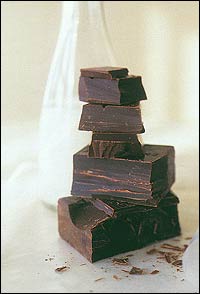
When making ganache, use a high-quality
chocolate. European-style “couverture” chocolate has an especially
high cocoa-butter content, and therefore flows freely when melted, is easier to
work, and sets with a glossier surface and a firmer snap: In short, it is
generally worth the extra expense. Because of the additional cocoa butter, it
also tastes richer and more chocolaty than most commercial bar chocolates. Good
brands include Valrhona, Lindt, Callebaut, Tobler, and Scharffen Berger (a
fairly new American chocolate).
Ganache recipes often call for pasteurized heavy cream; ultrapasteurized cream, the type most commonly available at the supermarket, can have a caramelized taste, so seek out pasteurized cream if you wish to avoid this. Since heavy cream is approximately 35 percent butterfat, combining it with chocolate that has a high cocoa-butter content yields a mixture that, depending upon the chocolate, may feel too oily. Once you’re comfortable working with ganache, you can try mixing heavy cream with half-and-half to bring down the fat content.
The chocolate must first be chopped into small pieces, so that it will melt evenly. If you leave it in large chunks, the outside surface will melt long before the center begins to soften, and the melted portion will stay hot too long which can ruin it. Use a heavy serrated knife (or a chocolate chopper) to shave off shards of chocolate; these can then be chopped again with the knife, or transferred to a food processor fitted with a steel blade and pulsed briefly; be careful not to let the chocolate melt in the processor bowl.
Next, the hot cream is poured onto the chocolate
(some cooks prefer to pour the chocolate onto the cream), and the two are
gradually blended by stirring. Treat this process as gently as you would a
mayonnaise, incorporating the cream into the chocolate steadily, without
over-working. The molten chocolate and cream will blend slowly, and then become
smooth and glossy: This glossiness is a good sign that the suspension is stable.
But don’t mix your ganache for too long or you will drive the cocoa solids out
of suspension and wind up with a dull, gray, grainy mess – a “curdled”
ganache. There are a variety of tricks for fixing a separated ganache. The whole
batch can be put into a food processor and whirled for a few seconds, for
example. Other methods include mixing in a couple of tablespoons of hot cream or
whisking the broken ganache with the whisk submerged (so that no air is
incorporated).
Flavorings can be added at several points in the
process. Some herbs and spices (like rosemary, lavender, and fennel seeds) can’t
be used whole; their textures would spoil a satiny ganache. These should be
infused into the cream after it is heated, then strained out before it is poured
onto the chocolate. Or try the method preferred at Bouley for many of their
flavored ganaches: cold infusion, where the ingredients is ground or chopped and
blended with cold cream, then allowed to sit overnight. This modern technique,
used with mint, Earl Grey tea leaves, and coffee beans, is believed to eliminate
bitter flavors that may develop during traditional hot infusion. Liquid
flavorings, like fruit purees, liqueurs, and alcohol-based essences like
vanilla extract, should be added to the warm blended ganache; their flavors
would be altered by the hot cream.
To the chocolate lover, however, flavorings are
beside the point. A pure, plain ganache is luxury enough. There is no
compromise, no adulteration, only the welcoming acquiescence of cream-softened
chocolate.
HOW TO MAKE GANACHE
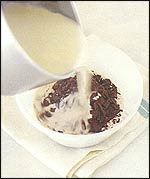
Making ganache involves using the warmth of
heated cream to melt chopped-up chocolate, then blending them with even
stirring.
The cream is brought to a boil, then poured onto the chopped chocolate. Let the
cream sit in the chocolate for a short while, until the chocolate begins to
melt.
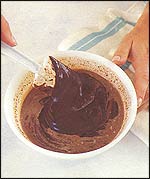
Stir the melting chocolate into the cream,
beginning near the center and gradually widening the stir to pull in more
chocolate as it melts, until you’ve combined all of the chocolate with the cream
and have a smooth, glossy liquid. Try to get all the chocolate into solution,
but don’t be disappointed if it doesn’t all dissolve – overworked ganache
curdles (it’ll still be delicious but it will look dull and may be grainy).
Strain out undissolved lumps.
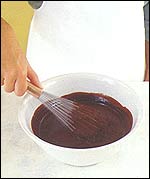
incorporated air, giving it body and volume.
HOW TO MAKE TRUFFLES
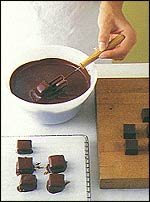
Chocolate truffles are ganache in its
simplest form, wrapped in a thin cloak of chocolate or a dusting of cocoa. When
the ganache is first made, it is still too warm and soft for wasy handling:
Cover the bowl with plastic wrap, pressing the film onto the surface of the
chocolate to prevent a thin skin from forming, and refrigerate. After about a
half hour, remove the chilled, firm ganache from the refrigerator and form
truffle centers with a teaspoon: The ganache is so rich that smaller sizes (no
more than an inch) are preferable. For square or rectangular truffles, ganache
is chilled as a shallow sheet, and then cut down to size. Spherical truffles
must be formed by hand: Use fingers to gently press the ganache into a rough
sphere, then smooth it, if desired, by rolling briefly between your palms. It’s
a messy business (and one that children love). Uncoated truffles should be
rolled in cocoa powder or other dry coverings and then transferred to the
refrigerator; without a chocolate shell, they will melt at warm room
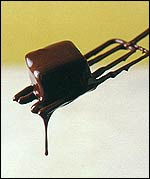
temperatures. For dipped truffles, the ganache is dropped into tempered
chocolate, rolled to coat, and then lifted out on a chocolate-dipping fork.
Excess tempered chocolate is shaken off by tapping the fork against the side of
the bowl; the truffle is then placed on parchment paper to set for at least an
hour. While the truffle dries, it can be decorated with drizzles of tempered
chocolate, or by pressing dry ingredients like pieces of nut or dried or candied
fruit into the still-soft surface.
SIMPLE CHOCOLATE TRUFFLES
Keep these truffles chilled until ready to
eat.
1 pound bittersweet chocolate
1 cup heavy cream
Best-quality cocoa powder
Chop chocolate finely using a serrated knife, and
place in a large heat-proof bowl.
Bring cream to a boil over medium-high heat; pour
directly over chopped chocolate. Allow to sit 10 minutes; use a rubber spatula
to gently stir chocolate and cream until combined. Allow to sit at room
temperature until just thickened, about 15 minutes.
Pour ganache mixture into a shallow glass dish.
Cover with plastic wrap, and refrigerate until mixture is very cold and set but
still pliable, about 30 minutes.
Using a small spoon, scoop out ganache into
1-inch nuggets; place on a parchment-lined baking sheet. Chill for 10 minutes.
Use fingertips to mold truffles into round shapes. Roll in cocoa powder to coat;
chill in an airtight container until ready to serve.
Makes 3 dozen.
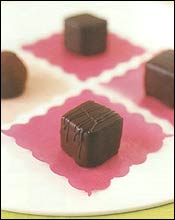
DIPPED CHOCOLATE TRUFFLES
Tempering chocolate requires measuring
temperatures exactly with a chocolate thermometer. To get a clean cut, you may
have to rechill truffle mixture periodically to keep it at the temperature
that’s easiest to work with.
Butter for pan
1 pound bittersweet chocolate
1 cup heavy cream
Tempered Chocolate (recipe follows)
Butter an 8-inch square pan; line bottom with
parchment. Chop chocolate into 1/4-inch pieces; place in a large heat-proof
bowl.
Bring cream to a boil over medium-high heat; pour
directly over chopped chocolate. Allow to sit for 10 minutes; use a rubber
spatula to stir chocolate and cream until totally combined. Pour mixture into
prepared pan. Cover with plastic wrap; chill until mixture is cold and set, 30
to 45 minutes.
Turn ganache onto a cutting board. Using a very
sharp knife, trim edges to form right angles. Cut into 7 strips about 7/8 inch
wide. Cut strips crosswise to form cubes. Place on a parchment-lined tray; chill
for 5 minutes if soft, otherwise proceed to next step.
Once chocolate is tempered, use it immediately.
Drop truffles into tempered chocolate one at a time; turn over to completely
cover. Use a chocolate-dipping fork to lift truffle out. Tap fork; allow excess
to drip back into bowl. With a second dipping fork, slide truffle onto a
parchment-lined tray. Working as quickly as possible, repeat with remaining
truffles (if tempered chocolate cools too much, it goes out of temper). When all
truffles are dipped, you may drizzle with excess tempered chocolate.
Allow truffles to sit for at least an hour or
overnight to fully set. Store at room temperature in a cool dry place.
Makes about 4 dozen.
TEMPERED CHOCOLATE
We used dark Valrhona chocolate. Temperatures
vary with different chocolates. Call the manufacturer or check the package for
proper tempering temperatures for the chocolate you choose, but always use
top-quality chocolate. Do not use a wooden spoon to stir. Be careful not to let
any water droplets get in the bowl of chocolate, and be sure the thermometer tip
is not touching the bottom of the bowl, or the temperature reading will be
inaccurate.
1-1/2 pounds bittersweet chocolate
Chop 1-1/4 pounds chocolate into bite-size pieces
with a serrated knife; place in a dry metal bowl.
Bring a saucepan with 1 to 2 inches of water to a
simmer; turn off. Set bowl of chocolate over saucepan; melt. Stir gently with a
rubber spatula until it reaches 118°F on a chocolate thermometer. Remove bowl
from saucepan; add remaining chocolate to melted chocolate. Stir with a rubber
spatula until melted chocolate cools to 84°F; remove unmelted pieces. Place
bowl over pan; stir until thermometer reaches 88° to 90°F. Use immediately.
Makes enough for 4 dozen truffles.
HOW TO MAKE GANACHE CAKE
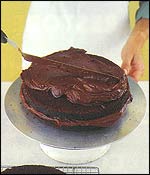
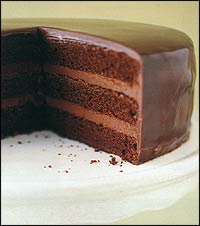
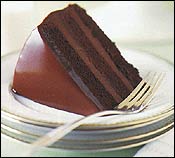
The truffle cake is chocolate cake at its
most exalted: layer upon layer of chocolate. For maximum effect, the cake’s
finish should be as perfect as possible, with even sides and a mirror-smooth,
glossy surface. The cake is architechturally straightfoward – three cake layers
filled with whipped ganache and topped with a ganache glaze. After baking the
layers, trim them with a serrated knife to get them level before applying the
whipped ganache filling. Whisking aerates a ganache, giving it volume and an
airy, mousselike consistency.
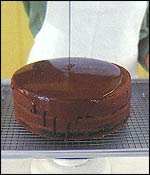
By varying the proportions of cream and the
whisking time, whipped ganaches of different density are achieved. For most
layer-cake fillings, an approximately equal ratio of chocolate and cream are
used, but a lighter sponge cake, like a genoise, benefits from an airy ganache.
If the ganache is overworked, cocoa butter and cocoa solids separate, and the
mixture loses its gloss: Curdling does not affect its taste but does change its
appearance and texture. To get a smooth finish, prepare the assembled cake for
glazing by applying a “crumb coat” – a layer of whipped ganache that
seals in crumbs on the cake’s surface. After refrigeration, the ganache glaze
should be poured, occasionally shaking the base to redistribute the glaze
evenly: A spatula can be used to spread the glaze, but try to work it as little
as possible to guarantee an elegant sheen.
LUSCIOUS CHOCOLATE CAKE
1 cup (2 sticks) plus 2 tablespoons unsalted
butter, room temperature, plus more for pans and parchment
1/2 cup plus 1 tablespoon best-quality coca powder, plus more for pans
3/4 cup milk
2-1/4 cup sifted cake flour (not self-raising)
3/4 teaspoon baking soda
1/2 teaspoon salt
1-3/4 cups sugar
2 teaspoons pure vanilla extract
3 large eggs, lightly beaten
1 recipe Whipped Ganache (recipe follows)
1 recipe Poured Ganache Glaze (recipe follows)
Heat oven to 350°F. Arrange two racks in center
of oven. Line bottoms of three 9-by-2-inch buttered cake pans with parchment;
butter again. Dust bottoms and sides with cocoa; tap out excess. Sift cocoa into
a medium bowl; stir in 1/4 cup plus 2 tablespoons boiling water until smooth;
gradually whisk in milk. Set aside to cool.
Sift flour, baking soda, and salt into a bowl.
Set aside. In an electric mixer fitted with the paddle attachment, cream butter
on low until fluffy. Gradually beat in sugar, scraping down sides twice. Beat in
vanilla.
Add eggs, a third at a time, beating after each
addition. With mixer on low speed, alternate adding flour mixture and reserved
cocoa mixture a little at a time, starting and ending with flour mixture. Divide
batter evenly among prepared pans; spread with an offset spatula until level.
Bake 20 to 25 minutes, rotating pans if
necessary, until a cake tester inserted into the center of each cake comes out
clean. Let cool in pans set on a wire rack, about 15 minutes. Remove the cakes
from the pans, and return to rack to cool, tops up.
Trim cake layers until level. Place one layer of
cake on a cardboard cake round. Spread about 1-1/4 cups whipped ganache on cake;
top with a second cake. Repeat. Spread remaining whipped ganache evenly over top
and sides of cake to seal in crumbs and form a smooth surface. Chill until crumb
coat is firm, about 30 minutes.
Place cake (still on the cardboard cake round) on
a wire rack set in baking pan. Pour enough ganache glaze over cake to fully
coat, shaking pan gently to help spread ganache if necessary. Let sit for 15 to
20 minutes. The ganache in the baking pan may be strained through a fine sieve
and added back into glaze. Pour remaining glaze over cake; allow excess to drip
off sides. If top is not smooth, gently shake pan, or run an off-set spatula
quickly over surface. Allow to set at least 30 minutes before serving.
Makes 1 nine-inch layer cake.
WHIPPED GANACHE
Ganache must be cold to whip properly.
1 pound bittersweet chocolate
2-1/2 cups heavy cream
Chop chocolate finely using a serrated knife, and
place in a large heat-proof bowl.
Bring cream to a boil over medium-high heat; pour
directly over chopped chocolate. Allow to sit for 10 minutes; use a rubber
spatula or a small whisk to gently stir chocolate and cream until totally
combined.
Chill ganache; stir every 5 minutes until mixture
is cool to the touch. Remove bowl from refrigerator; whip ganache with a wire
whisk until it just barely begins to hold its shape and is slightly lighter in
color. Do not overwhip, or mixture will become grainy. Ganache will keep
thickening after you stop whisking. Use immediately.
Makes about 4 cups.
POURED GANACHE GLAZE
The ganache gets thicker as it sits. You want
it pourable but thick enough to fully coat the cake.
1 pound bittersweet chocolate
2-1/2 cups heavy cream
Chop chocolate finely using a serrated knife, and
place in a large heat-proof bowl.
Bring cream to a boil over medium-high heat; pour
directly over chopped chocolate. Allow to sit 10 minutes; use a rubber spatula
to gently stir chocolate and cream until combined. Allow to sit at room
temperature until just thickened, about 15 minutes.
Makes about 4 cups.