
TYPES:
-
Sliced cookies are made from a stiff dough that is generally formed into a roll, sliced,
and baked on sheet pans. Care should be taken not to overmix the dough or incorporate
extra flour during mixing because this will toughen the cookies. These cookies also
can be rolled out and cut into squares, circles, or fancy shapes. The method of forming
the dough into a roll and then slicing the roll into uniform pieces saves time and eliminates the problem of leftover dough. It is very important that the roll be uniform and that the slices be of the same thickness to ensure even baking of the cookies. -
Drop cookies are made from a soft dough. A spoon or pastry bag may be used to drop
the cookies onto the sheet pans. Drop cookies should all be the same size to ensure even
baking. -
Bars are baked and then generally cut while warm to avoid breakage. They may be
formed from rolls of dough flattened in a sheet pan (See illustration ) or from dough
spread into a sheet pan before baking. -
Brownies are very rich cookies. The batter is quite heavy and must be smoothed in
the sheet pan to ensure an even thickness.
GUIDELINES FOR SUCCESSFUL COOKIE BAKING
-
DO NOT use warped or bent baking pans. Use only lightweight sheet pans (weighing
about 4 lb) designed for baking. -
Follow the recipe instructions regarding greasing pans as some cookies require a greased
pan for baking but other cookies have enough fat in the dough to eliminate the need for
greasing the pan. Heavy greasing encourages spreading of the cookies. Use cool, clean
sheet pans because cookie dough will melt and spread too much if a hot sheet pan is used. -
If cookies are to be cut into special shapes, the dough should be rolled out to 1/4 to
1/2 inch thickness on a lightly floured board, cut into the desired shapes, and baked as
directed in the basic recipe. If cookie cutters are not available, an empty can of the
desired size may be used. The can should have both ends removed, be thoroughly
cleaned, and have the edges smoothed before it is used. -
To cut a roll of cookie dough into even slices, it is suggested that a clean piece of wood
or metal be notched according to the width desired for each cookie, and be used as a guide
in slicing. For sliced cookies, a dough scraper should be used to cut the roll of cookie dough. -
Make each cookie the same size and thickness. Space them evenly on the pan to ensure
uniform baking. Cookies may be flattened with the bottom of a small can or glass dipped
in sugar. Cookies may also be flattened with a fork to make a crisscross design on the top. - If less than a full pan of cookies is to be baked, the cookies should be spaced evenly in the center of the pan to ensure even baking.
-
Avoid overbaking cookies. Always test for doneness. Overbaked cookies become dry and
lose their flavor rapidly. -
Most cookies should be loosened from the pans and removed to other pans or racks
to cool. Cookies will continue to bake if left on the hot pans and will be difficult to
remove when cool.
DIRECTIONS FOR MAKE-UP OF ROLLED BAR COOKIES
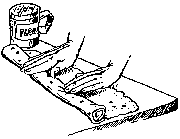 1. Form dough strips for fruit bars on floured board. |
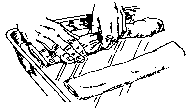 2. Flatten to desired thickness |
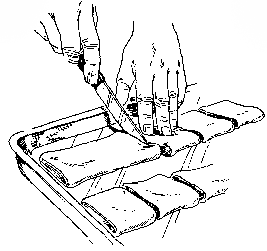 3. Cut baked fruit bars |