
CARE &
HANDLING OF CHICKEN
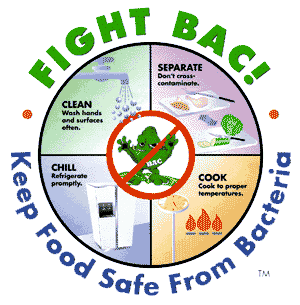
Bacteria are all around us.
Most of them are harmless. Some of them are even beneficial, like
the ones used to make yogurt. But, others can make you really sick
if allowed to grow and multiply!

He’s one of the harmful bacteria! He could be on
ANY food, unless you follow these
four simple steps.
- Chill promptly
- Clean your hands and kitchen
surfaces often - Separate, don’t
cross-contaminate - Cook thoroughly
So CHILL OUT and
keep it clean. Because if you want to stay healthy, you have to
Fight BAC!TM
Poultry Handling and Storage
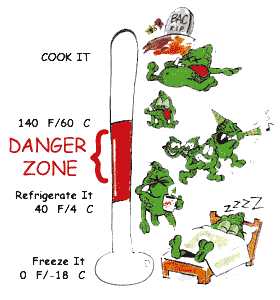
Life Begins at
40
(Degrees Fahrenheit)
Keep meat and poultry either below 40° F
(4^(o) C) or above 140^(o) F (60° C)
The Meat
Poultry
Thermometer
Chill it…When
Shopping
Choose packages of poultry that are cold and tightly
wrapped, without tears or
holes.
Check labels for a
“packaged on” date or “best before” date. Quality and food safety decrease after
the “best before” date.
Ask
the cashier to pack poultry with any frozen items to keep
them cold longer.
Keep It Moving 
Pick up poultry, refrigerated and frozen
foods last. Get these foods home and into a refrigerator or freezer
IMMEDIATELY.
Chill it…In The Refrigerator (at 40° F/4°
C or colder)
Promptly put store-wrapped poultry into the meat compartment
or on a plate on the bottom shelf of the refrigerator so they can’t
drip onto other foods. 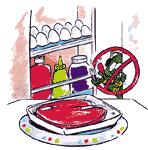
- If you will not use ground poultry within 1 day, freeze
it. - All other poultry can be refrigerated for 1-3 days.
Freeze them for longer storage.
Tips:
- Always marinate food in the refrigerator.
Storage Chart
|
POULTRY |
REFRIGERATOR* |
FREEZER |
|
Ground Poultry |
1 Day |
2-3 Months |
|
Whole Chicken |
2-3 Days |
12 Months |
|
Chicken Pieces |
2-3 Days |
6 Months |
|
Cooked Poultry |
3-4 Days |
2-3 Months |
* Number of days from the “packaged on” date, or the purchase
date if you buy from a full service butcher.
Chill It…In The Freezer (at 0°
F/-18° C or colder)
Immediately freeze any poultry
that you don’t plan to use within 1-3 days (see
Storage Chart). If in any doubt as to when you’ll use
it, freeze it – it can always be defrosted. This is especially
important for ground poultry.
Sometimes you’ll see
stickers on packages or signs near the meat case that say
“previously frozen” or “contains previously frozen product”. Do
not freeze this meat or poultry. Instead, refrigerate and cook
within 1-3 days (as specified in Storage
Chart) OR cook before freezing.
Q:Why does frozen poultry sometimes have dried-out
white patches?
A: This is “freezer burn” and is caused by poor
packaging and/or leaving foods in the freezer too long.
Freezer-burned poultry is safe to eat, but it may be less juicy and
tender.
Keep It Under Wraps
To
prevent “freezer burn”, wrap the package in plastic freezer bags or
heavy-duty aluminum foil. Squeeze out as much air as possible before
sealing.
Tip: If you buy large family packs,
divide them into individual or meal-size packages. Wrap for the
freezer and label with the date, cut of poultry and weight of each
package or number of servings.
Chill It
When Defrosting
NEVER defrost poultry at room
temperature.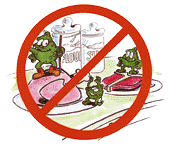
The safest way to thaw poultry is in the
refrigerator, allowing 6-9 hours/lb. (14-20 hours/kg). Place it in
its freezer wrapping on a tray or plate on the bottom
shelf.
Poultry defrosted in the microwave should be cooked
immediately. When defrosting ground meats/poultry in the
microwave, remove the outside portions as they thaw. This keeps the
outside from starting to cook before the inside thaws.
Q: My freezer quit and the poultry is starting to
thaw. What should I do?
A: Ground poultry should NEVER be refrozen. If partially or completely
defrosted but still cold, cook first and then freeze if
necessary.
As long as the poultry is still full of ice
crystals, they can be safely refrozen.
If the
poultry has completely thawed but is still very cold, cook it
and freeze it as cooked product.
If the poultry is
no longer cold, it must be discarded. This is
especially important for ground poultry
products.
Q:I left poultry on the counter to defrost and forgot
about it. Is it still safe to eat?
A: No. Always defrost
poultry in the refrigerator, not on the counter. Room temperature
allows bacteria to grow on the surface of the meat, even while the
inside remains frozen.
If In Doubt, Throw It
Out!
Chill It
When Storing Leftovers
Remove poultry meat from the bones and take the stuffing out of
the cavity. Refrigerate cooked poultry and stuffing promptly after
serving. Divide large quantities of food into smaller portions or
spread out in shallow containers to chill more quickly. Although
cooking destroys bacteria, new bacteria in the air and on surfaces
can recontaminate the food. These multiply quickly at room
temperature.
Clean It
Wash Hands and Surfaces Often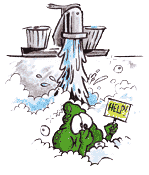
- Thoroughly wash hands, utensils, cutting boards and work
surfaces before, during and after handling raw poultry. - Always wash plates and utensils used for raw poultry before
using them for cooked meat or other foods.
Seperate It
Don’t Cross-Contaminate
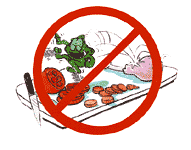
Take care that juices and marinades from poultry do not drip onto
other foods. Keep raw poultry separate from cooked meats or cold
cuts in the refrigerator.
Prevent cross-contamination by using
separate cutting boards for meats, poultry, fruits and vegetables,
and breads. Clean cutting boards in the dishwasher or scrub with hot
water and detergent after each use.
It is NOT
necessary to rinse poultry before preparing it.
If you
want to use a homemade or bottled marinade to baste poultry during
cooking (or to serve as a sauce), save 1/4 cup (50 mL) before
marinating. Brush the saved mixture over the poultry several times
during cooking. Throw out leftover marinade.
Cook It
Cook To Proper
Temperatures
Take poultry directly from the refrigerator to the barbecue or
oven.
Stuff poultry just before cooking.
Cook thawed poultry
just as you would fresh product. Cook until “done”; partial cooking
may encourage bacterial growth. Oven temperatures should be no lower
than 325oF (160oC) for poultry.
The best
way to judge doneness is to use a meat thermometer. Put the
thermometer into the centre of poultry stuffing, or into the
thickest part of the thigh in unstuffed birds. Stuffing should reach
165oF (74oC) before serving.
Doneness Chart
|
POULTRY |
DONENESS/TEMPERATURE |
|
Whole Chicken |
180 – 185 F (82-85 C) |
|
Chicken Pieces |
180 – 185 F (82 – 85 C) |
Q: Can I eat rare burgers?
A: No.
Ground poultry must always be cooked to well done or
until centres are no longer pink and juices show no pink
colour. This is because any bacteria that may be on the surface of
the raw meat or poultry can be mixed throughout the meat during
grinding.
Note:
Adding bacon or other hickory smoked products or
seasonings to burger mixtures may make the ground meat stay pink
even when it is fully cooked.
Brought
to you by the following founding members of the Canadian Partnership
for Consumer Food Safety Education:
Beef Information
Centre
1-888-248-BEEF
Further Poultry Processors of Canada
(613)
738-1175 Canadian
Poultry and Egg Processors Council
(613) 724-6605
Canadian Turkey Marketing
Agency
Chicken
Farmers of Canada
Canadian Meat Council
(613) 729-3911